⌕
JR
Jeff Reed
Hey, David, just to open up here, tell us your story.
DN
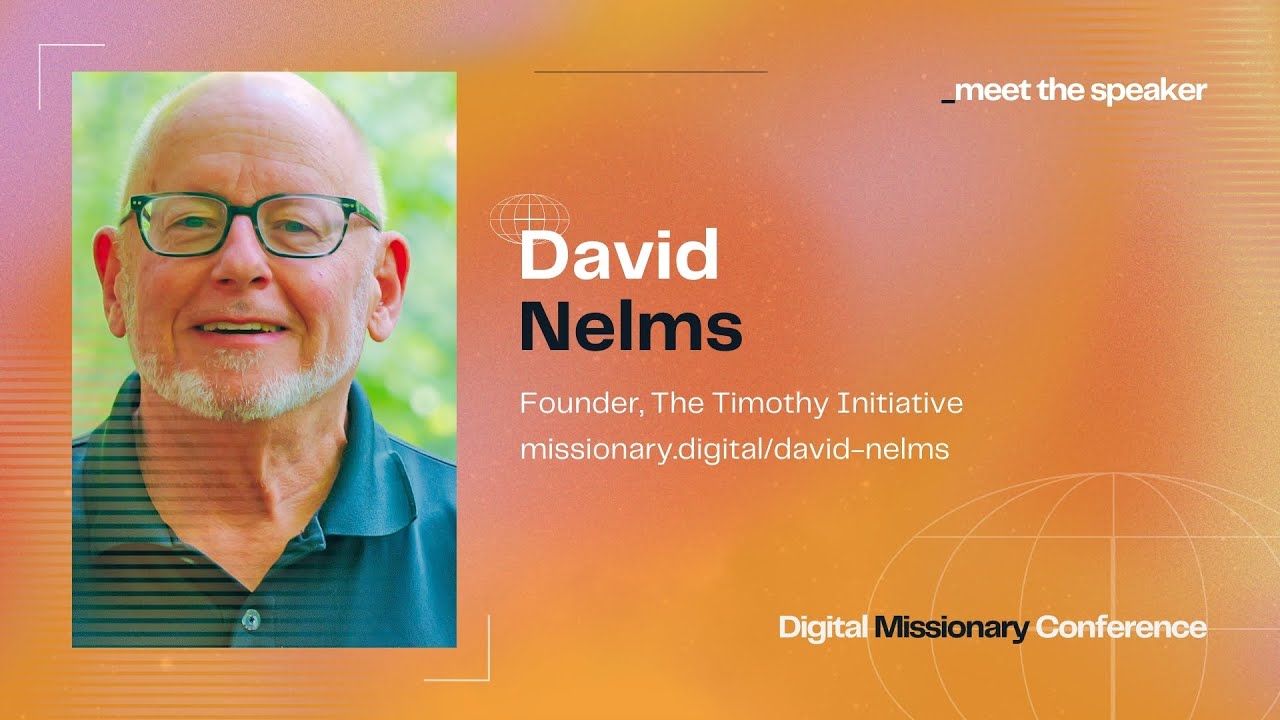
David Nelms
Yeah, Jeff, it's good to see you, buddy. Yeah, I've been a pastor all of my life. I pastored 37 years. Church planter, really. Started a church in Maryland, restarted one in Iowa, and then took a church in South Florida. And so I'm really just an old pastor. And I've always... been just excited about missions in the sense of ends of the earth stuff. It bothers me that 2,000 years after Jesus told us to tell everybody the good news, there are still billions out there that have no idea, never heard the gospel. Many of them never heard his name. So all my life, I have been real active in... in missionary work, primarily in your developing world, your Asia, Africa, some Latin America.
JR
Jeff Reed
Very, very cool. Now, you used to be a lead pastor of a church, and now you've transitioned and you're running this organization called the Timothy Initiative. Maybe share a little bit of that transition of how you went from a lead pastor of a church and getting into now a movement like Timothy Initiative.
DN
David Nelms
Yeah, well, like I said, I was very involved in missionary work. I used to, early on, Jeff, I would buy a few English study Bibles, put them in an extra suitcase, carry them over, look for a pastor that could speak English that would use the Bibles to make disciples. And I heard I got a master's degree at Moody and Moody used to teach. I don't know if they still do, but they used to teach that over 90 percent of the pastors in the world have had little to no theological training. And that's a major issue. And so I would take these study Bibles over. I would try to find someone that would actually use them. And it was probably better than nothing. I've never been accused of being a strategic thinker, okay? So I'm not sure how much good I did. Then I ended up on the board of a Bible college. that had several Bible institutes around the world. And they needed someone to kind of take it over. So I volunteered and got our church more involved with missions directly. And the people on the ground didn't know who was training them anyway. That was a whole lot better than my handful of Bibles in a suitcase. But nothing I saw ever reminded me of the Book of Acts. And the churches I was in, they all grew. They grew strong. A couple of them got pretty big. But it was nothing like the Book of Acts. And so I'm in this little village in Asia. And I saw some Muslim mosques. I saw a couple of Hindu temples. There was no church. And I asked the guy who was with us, I said, where's the church? And he said, oh, Dr. David, there's no church here. There's probably never been a church here. There may never be one. And Jeff, I'd been in many places before where there was no church. I'd been in places where they'd never heard the name Jesus. But it was something about that day. Over to the side, there was over the distance close by there, there was a rice paddy. And the young men were out in the fields working hard in that hot sun, just trying to feed their families. They're Muslims or Hindus. They love their children, their wives, as much as we love ours. And that's their life. If they don't work, they don't eat. Their family doesn't eat. Their wives were taking care of their babies. The old women were cooking over a fire, I guess getting lunch ready for the men. The old men my age were sitting under a tree debating something. Little children were running around like little children all over the world, playing. Some of them were naked. None of them had shoes on. Their toys, I remember, were sticks. branches one of them had a water bottle plastic dried up no water in it and it just struck me jeff these people are not rejecting jesus christ they don't know who he is and they don't know who he is because nobody has ever told them and It was like grief, just agony. I mean, these are people, I believe there's a heaven and there's a hell and that Jesus is the way and apart from him, you're separated from God for all eternity in that place called hell. And these people, they've never been told. And that's on us. It's on me. So I felt like the Lord was saying to me, I want you to do something about this. All I've ever done is plant churches. That's all I know. So I went back and told my elders, guys, we need to start some churches. They said, okay, let's do it. So that's kind of how we began to transition.
JR
Jeff Reed
Wow. And so you started that transition years ago. Like put a number on that. What year was that when you got started with the Timothy Initiative?
DN
David Nelms
Well, that trip I took was 2006. In 2007, we gathered together across four countries in Asia, 160 what we call Pauls now, but pastors. All the training is done through the local church. We're a real big local church, okay? Jesus didn't start a missionary organization. He started a church, okay? And so the first year, 2007, we found a curriculum, and we trained the Pauls through that curriculum the first year. I just want to make sure they knew what they were teaching. the actual training of the church planters that we call Timothy's, Disciple Makers Church Planters, started early 2008. And so it's been, I guess we're in our 17th year now, 17th, 18th year.
JR
Jeff Reed
So less than 20 years, less than two decades from that, your goal is to train 180,000 Timothys, 180,000 disciple makers over the next year or so. It's a two-year process. Yeah.
DN
David Nelms
when you were getting started back 17 years ago did you ever imagine you'd get to this point like what were some of those early early days as you were thinking about how this thing would span out oh yeah we never the original goal was to plant 7 000 churches and but we hit that pretty quick we hit it in about three years or so and then we upped the goal to forty thousand And I thought that would keep me busy for the rest of my life. And we passed that good night 10 years ago. So it's been amazing. It's something that only God can do.
JR
Jeff Reed
Amen. Do you actually have numbers? Can you quantify what that spread is? How many churches, how many churches planted, how many Timothys you have at a global scale?
DN
David Nelms
Yeah, the last time I looked, which was about a month ago, we were at 227,000 churches that had been started. And I don't remember how many Timothys, but currently or this year, our training centers don't all open at the same time. They're staggered during the year. And we're in 45 countries right now. And there's always a tidal wave or an earthquake or a coup or a revolution or something's always going on where we work. But by the time all the training centers are open this year, we'll be training somewhere around 180,000 disciple makers. The training goes for two years. And so during that two years, we would hope to see another, I'm hoping for 100,000 churches, maybe a little less, and that could be a little more.
JR
Jeff Reed
Now, a couple things. One, two-year process for your discipleship. And actually, I've got, you shipped me a decade ago, years ago, like every book that was in the Timothy Initiative in that two-year process. It's an overwhelming resource. Like, as you look at discipling, making a Timothy, doing it, two years going throughout the discipleship process? Is there a reason why? What are you looking for, hoping to ingrain into Timothy's, into your disciple makers over that two-year period?
DN
David Nelms
Yeah, Jeff, we believe that one of our core values would be, and I'm going to say it in a very long way, we've got it shortened down, but basically we would say to see a healthy, sustainable church planting, disciple making movement, there are two non-negotiable essentials. And those two are the Holy Spirit and the Holy Scriptures. You receive the Holy Spirit at birth, at new birth, but the Holy Scriptures take time to learn. What I've observed, and this is a generalization here, okay? There's going to be exceptions. But what I've observed is in the parts of the world we work in, they're real big on the Holy Spirit, okay? Those guys can call fire down from heaven. They tend to be weak on the scriptures, not because they don't respect the Bible. There may not be a Bible translated in their language. Some of them have never owned a Bible and some of them can't read and write. Here in the West, we tend to be really big on the Scriptures. I mean, if you think about the way we disciple, it's podcasts, seminars, conferences, small groups, sermons, Bible college, it's all knowledge-based, okay? Nothing wrong with knowledge, but it's all knowledge-based. But we tend to be light on the Holy Spirit. And when you put those two together, the Holy Spirit inspired the Holy Scriptures for a reason, okay? People need to be grounded in the scriptures. Jesus, by the way, it is true that his disciples turned the world upside down, but it's equally true they spent three years being trained by Jesus. And literally every time he opened his mouth, the scriptures came out. So he was, they were just immersed in the scripture. So we feel that, you take just Africa, I would guess there's 10,000 different cults across the continent of Africa. And because people have, pastors have not been grounded in the scriptures. those new churches can become just all kinds of problems.
JR
Jeff Reed
As we talk about movement, movement thinking, what actually for you, what defines a movement? What's the secret towards adapting a movement mindset?
DN
David Nelms
Well, from a missiological perspective, to be a movement requires the church plants go four generations deep. So church A plants church B, church B plants church C, church C plants church D. A minimum of four deep. a minimum of 100 wide. So all four of them keep planting churches that keep planting churches. They're led by indigenous people that are raised up there in the ministries, as opposed to sending off to a Bible college somewhere to hire somebody. And it's done in a relatively short period of time. two, three, four years. And there's just nothing like that that I'm aware of in the United States. It may be happening. We need it to happen. But overseas, around the world at least, I think last I heard there's over 1,900 different... movements that would meet that qualifications I just mentioned that are being tracked around the world. We're blessed to be a part of several of them. And listen, there's nothing like a movement. When I first saw it up close and personal, I drank the Kool-Aid. It changed my life forever. I mean, what pastor would not want to lead someone to the Lord and disciple them? and have that person lead someone of the Lord and disciple them and have that person lead someone of the Lord and disciple them and have that person. And it just keeps going. And so, yeah, a movement, that would be from a missiological perspective, the definition of a movement. We use the word movement a lot today, kind of like the word love or the, you know, I love pizza and I love my wife, but you can't compare the two, okay? We kind of overuse the word. And I'm not sure that everyone that uses the word movement really understands what they're talking about. But it's four gen deep, minimum of 100 wide, local indigenous leaders being raised up to lead it all. It's a pipeline and it's done pretty quick. It moves. And by the way, you can see growth without making disciples. In fact, I would say here in the States, we have maybe mastered the art of that. We figured out how to spend millions of dollars to start churches and make very few disciples, okay? So you can start churches without making disciples. You can't make disciples without seeing churches spring up. At least that's been our experience. And to see a movement take place, Jeff, I think there has to be a strong, focused intentionality on not making disciples, but more on making disciples who make disciples. We would say, well, there's a slogan that's used all over Asia that we've kind of adapted or adopted rather, I'm sorry. And it goes like this, every believer, a disciple, every disciple, a disciple maker, every disciple maker's home, a potential church. every church, a church planting training center. And when that is your ministry philosophy, you're no longer, if I were going to disciple you, if you were a new believer, Jeff, you're still a young man. And if I were your pastor before years ago, I would have just focused on you. teach you how to study the scriptures, teach you how to pray, teach you how to be a good steward, be a good husband, be a good dad, get you in a ministry, get you in a small group, no more. Now, I would not so much just focus on you, but I'd be looking at the person behind you. And the goal is not to make a disciple, but the goal is to make a disciple who makes a disciple. And everything in our training, I mean, from day one, from the very first day, that's being emphasized. And by the way, it is true Matthew 28, 19 says the Great Commission, go make disciples. But it's equally true the next verse says... teach them to obey everything I've taught you. He just taught them to make disciples. So what the Great Commission really states is make disciples who make disciples. So we're not making disciples, we're making disciple makers. And that may sound like semantics, but it changes everything. It moves you from addition to multiplication. It's what happens.
JR
Jeff Reed
Well, you know, and we, I quote 2 Timothy, I think it's 2-2. Paul, with an audience of many, trains Timothy, who will train others, who will train others. And there's like five generations in that as well.
DN
David Nelms
Yeah, that's where we take our name. That's where the Timothy initiative comes from, 2 Timothy 2-2. And in our training, we aim for, during that two years, we aim for four generations. We don't always hit it. Sometimes we fail miserably. Sometimes we do a little better, but that's the goal. And so I heard a pastor say one day, he made this statement to me and it was just so good. He said, I'm sitting there in his office talking to him out in the middle of Iowa. And he said to me, David, if you're not making disciples who make disciples, you're not making disciples because disciples make disciples. And I said, whoa, wait a minute. Say that again. I thought my head was going to explode. So he said it. I said, go slow. He said, if you're not making disciples who make disciples, you're not making disciples because disciples make disciples. By the way. I would ask your listeners to define, how do you define a disciple? What is a disciple? If we're going to make disciples, we need to know what a disciple is. And we would say a disciple is someone who lives like Jesus and leads others to do the same. Living like Jesus is the great commandment, loving God, loving people. Leading others to do the same is the great commission. Jesus said, if you follow me, I'll make you fishers of men. That's beautiful.
JR
Jeff Reed
I would say that looking at the digital landscape, now I'm not the expert in digital, and I'm learning so much at the global scale, so I'm hesitant to say this, but I really haven't seen... a lot of multiplication yet as I look at digital ministry, at digital mission work. Maybe it's too so new that we're really not seeing the multiplication, the disciple making disciples. We haven't seen that multiple generations yet. But I look at the technology that's available and how it operates at the big scale. Yes, it can be a megaphone, but it also can be very good at relationally connecting with individuals. And so there's an opportunity to maybe use these tools in a different way to start to not look at it at the grand scale, but to look at it on how to build relationships, on how to relational disciple individuals or people. or small groups of people and and training them i love that quote and i've heard that you've said that to me several times over the years if a disciple is not making a disciple uh are they really a disciple and starting to really understand that that multiplication aspect and are we digitally are we equipping our disciples to understand that level of responsibility are we equipping are we mobilizing are we holding them accountable to that well let me ask this As we're wrapping up here, what advice would you give someone starting out? We've got a lot of people that are listening that are relatively new in digital missions work, in being a digital missionary. We're talking about disciples making disciples, multiplication. For some, this is a new concept. They're moving from knowledge-based discipleship towards more of an obedience-based discipleship let's let's not just hear the word let's do what it says james 1 22 and so moving towards that what is something you've learned over the years the hard way that you can make it really easy for somebody right now to learn today yeah jeff uh most of my life i knew the great commission was make disciples but i thought
DN
David Nelms
I thought the best way to make disciples was by planting churches. And you can certainly make disciples that way. But I came to realize I had it backwards. More closer to the truth would be the best way to plant churches is by making disciples. Jesus never said, go plant a church. Now, I'm a church planter. If my wife were sitting here by me, she would say, that's my hobby. I'm all for church planting. But the Great Commission, again, is make disciples who make disciples. And one thing, a problem that we have here in the States, I think, is we get too focused on church growth. And church growth is seductive. It'll seduce you. Now, let me pause here. I'm not anti-church growth. I'm not one of those anti, some of our greatest partners in this country are huge churches. I'm one of those guys, if you're gonna buy a hundred chairs, you ought to put somebody in every one of them. And then when the service is over, fill them up again and then fill them up again. So I'm not, this is not an anti-growth thing here, okay? Tirade. But the goal is not church growth. The goal is to make disciples. I personally believe if you make disciples who make disciples, in the long run, you'll reach a whole lot more people. But I heard somebody say once, if you graph out multiplication, it kind of looks like this, and then it takes off. But if you keep multiplying, You've seen the graphs. It's just, it's exponential. And so don't get, we've been trying to grow by addition. We add in people. Today, we will plant over 100 churches today. every 13 minutes we plant churches, we will reach more people now in one day than it used to take me 10 years. to reach. That's the power of multiplication. So I would say to your listeners, focus on multiplication. Do not focus on church growth. Focus on church health. And if it is a healthy church, it will be a disciple-making church. And making disciples who make disciples who make disciples who make disciples, 2 Timothy 2.2, will eventually... lead to much greater growth than you would have seen doing it the other way.
JR
Jeff Reed
So that would be my suggestion. Beautiful. David, what a great opening to the conference here. I want to thank you for your time and insight joining us today as we're kicking off. And so thank you for that. Thank you, Jeff.
Auto-generated from audio, lightly cleaned for reading. · Watch the full episode →
